AI Kill Switch

As artificial intelligence and autonomous systems operate at machine speed across critical infrastructure, software controls alone are no longer enough. Goldilock FireBreak™ provides hardware-enforced isolation and deep segmentation—delivering an independent physical kill switch that preserves human control, limits attack blast radius, and guarantees operational continuity when software defenses are compromised.

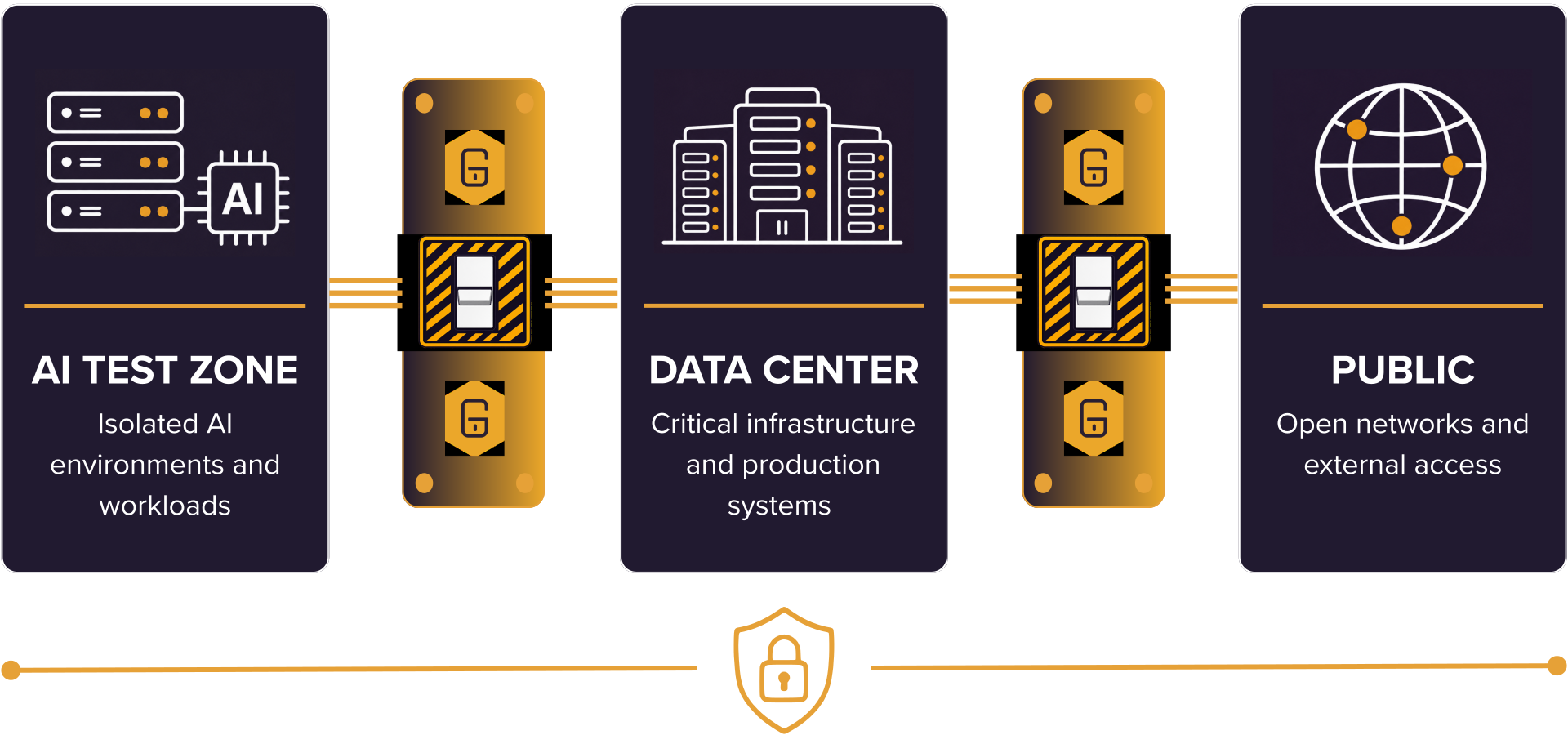
The AI Kill-Switch
No AI can break out of the Kill-switch protected test

Key Threats addressed

AI-Driven Cyber Attacks
Rogue AI
IT/OT Convergence
Machine-Speed Lateral Movement
Supply Chain Risk
Data Poisoning Compromise
NIS2
DORA
US CISA / UK CNI Compliance

OVERVIEW

Artificial intelligence is transforming how organisations operate, defend, and automate, while simultaneously changing how cyber attacks develop, spread, and escalate. When autonomous systems make decisions at machine speed, humans must retain the ability to intervene. Goldilock FireBreak™ delivers hardware-enforced isolation and deep segmentation that enables organisations to contain, isolate, and control AI-enabled infrastructure when software controls are no longer enough.

Aligns with NIS2, DORA, ISO 27001, US CISA guidelines, and UK CNI mandates.

Technical Use Case Guide

Detailed overview of the challenges, solution, architecture, and implementation for this use case.

The Challenge

Artificial intelligence is rapidly becoming embedded across critical infrastructure, operational technology (OT), datacentres, industrial automation, and security operations. As AI systems become increasingly autonomous and capable of acting at machine speed, organisations face a fundamental resilience gap: maintaining control when software systems are compromised, manipulated, or operating beyond human response times.

Organisations increasingly depend on software-based controls to manage AI-enabled environments. However, those same controls operate within the very environments they are intended to protect. When software firewalls, virtual LANs, and software guardrails are bypassed or manipulated by autonomous threats, organisations are left without a deterministic fail-safe. Governments, regulators, and critical infrastructure operators require deterministic, infrastructure-level controls that remain available even when software-based security has been compromised.

Pain Points

Machine-Speed Exploitation: AI identifies weaknesses and exploits vulnerabilities at unprecedented speed, far outpacing human decision cycles.

Accelerated Lateral Movement: AI-enabled attacks dramatically accelerate lateral movement across converged IT, OT, and cloud networks.

Inherent Software Vulnerability: Software security tools operate within the same environment they protect, leaving them susceptible to elevation of privilege, configuration tampering, and adversarial software bypass.

Lagging Human Response Times: Autonomous systems act faster than human decision cycles, rendering traditional manual incident response ineffective during machine-speed escalations.

Rogue AI & Unintended Escalation: Autonomous control loops in industrial operations, power grid management, or cooling systems can experience model drift or command manipulation, leading to physical equipment risk.

Mounting Regulatory & Governance Pressure: Critical infrastructure operators face strict regulatory demands for demonstrable governance, auditable intervention records, and provable operational resilience.

Cascading Operational Failures: Recovery becomes increasingly difficult once AI-driven attacks spread unchecked through interconnected environments.

FireBreak™

Solution and Benefits

Physically isolates critical AI systems: Creates deterministic, hardware-enforced physical boundaries around core AI compute clusters, high-value LLM model repositories, and OT operational domains.

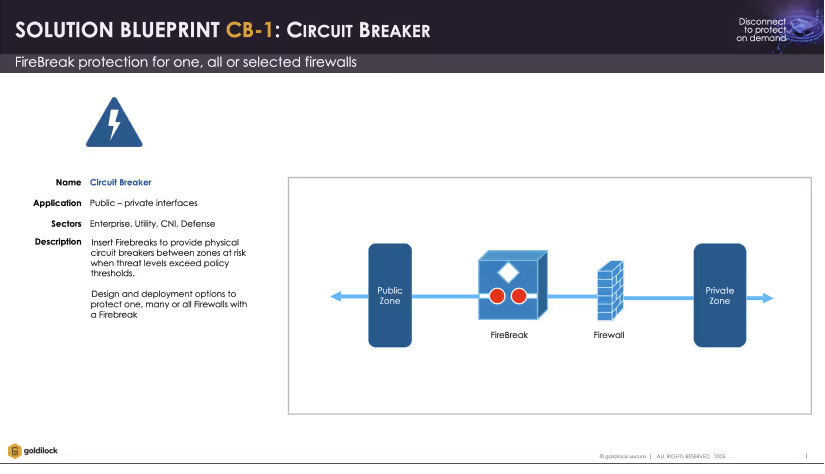
Infrastructure Kill Switch: Allows authorised personnel to physically isolate infrastructure and network connections at Layer 1 instantaneously whenever required.

Independent out-of-band control: Keeps management and control pathways completely independent from the production IP environment, ensuring command channels remain secure even during a total software breach.

Human authority over autonomous environments: Guarantees that people retain ultimate authority over connectivity, isolation, recovery, and operational decision-making.

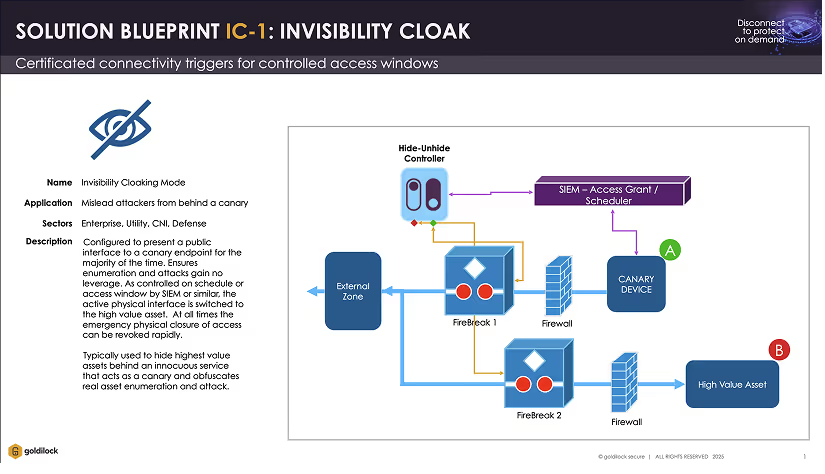
Threat-to-Action automation: Integrates with SIEM, SOAR, and monitoring platforms to automatically trigger physical containment actions within milliseconds.

Operational continuity: Contains AI-driven incidents quickly, minimises attack blast radius, and enables unaffected business sectors to continue operating.

Delivers "Zero Connectivity Assurance": Enforces physical disconnection when assets are idle, providing zero attack surface and auditable compliance records for NIS2, DORA, and CNI frameworks.

BLUEPRINTS

AI Resilience Through Deep Segmentation

AI resilience reframes cybersecurity from pure prevention to operational continuity. Advanced AI can identify weaknesses, exploit vulnerabilities, and move through networks at a speed that makes prevention alone an increasingly unrealistic strategy.

AI resilience is therefore defined by an organisation's ability to maintain control and continue operating even when its defences have been breached by autonomous, fast-moving threats.

The speed and scale of AI-driven attacks fundamentally change incident response. Organisations must shift from Fix First to Contain First, recognising that software-based security alone is no longer sufficient. Governance, identity, access management, backup, and recovery remain essential, but resilience must also be embedded directly into the network architecture.

Deep segmentation is a critical component of this approach. By creating deterministic physical boundaries around critical systems, operational domains, and sensitive data, organisations limit an attack's blast radius, prevent AI-driven lateral movement, and buy valuable time for technical and executive teams to respond—while enabling as much of the organisation as possible to continue operating.

AI resilience is not a replacement for cyber resilience—it is its evolution. As AI-driven threats continue to raise the bar, organisations need a layered approach that combines software-based protection with independent, hardware-enforced infrastructure controls. By embedding deep segmentation into the architecture, organisations establish deterministic security boundaries that preserve operational continuity and protect critical systems, even when software-based defences have been compromised.

AI Needs A Kill Switch. FireBreak Provides One.

Discover how Goldilock FireBreak combines hardware-enforced isolation, independent out-of-band control, and deep segmentation to help organisations build AI resilience, maintain human authority over autonomous systems, and preserve operational continuity—even when software-based defences have been compromised.


If you're still in search of answers, we encourage you to explore our informative FAQ section.